Showing posts with label The Mary Sue. Show all posts

Tuesday, January 2, 2018

The Jedi & Toxic Masculinity

Anakin Skywalker from "Revenge of the Sith" GIF (unknown origin)
Anakin Skywalker
from Revenge of the Sith
(GIF unknown origin) 
I just read a fascinating article on The Mary Sue by Kaila Hale-Stern about Pop Culture Detective's video "The Case Against the Jedi."

(As all the links above should indicate, this post's content constitutes little -- very, very little -- of my own original thought or language.)

I have always wrestled with the central focus on detachment propounded by Buddhist and other philosophies, so it comes as no surprise to me that this article/video appeals to me.

I don't know whether it is because I am a woman, or an Aquarius, or just too stubborn and willful for my own good, but I have always found my passions to be too valuable to sacrifice to an ideal of pure peace from reason.

Thus, the article/video's assertion that
“Luke doesn’t take the Jedi orthodoxy surrounding emotional detachment to heart,” Pop Culture Detective notes. “Luke Skywalker is at his very best when he doesn’t follow the path of the Jedi.” It’s Luke’s caring heart and his trust in the innate emotional bond of family that turns the entire tide of the original Star Wars trilogy. And it’s the former Anakin Skywalker’s lingering, unsuppressed emotion for his child that allows that to happen.
really, really appeals to the passionate subversive rebel heart at the core of my being.

Luke Skywalker from Return of the Jedi
(GIF unknown origin)
Even as I used Joseph Campbell's heroic paradigm to organize how I taught literature to teenagers, I struggled with the notion that women function primarily as symbolic components of the male hero's journey rather than having agency of their own.

However, perhaps I was wrong. Yes, women are often depicted in myth/story as part of the prize the hero gets to return home to if he successfully dies to himself and all his former attachments and transcends to an idyllic agape love for all life. (At which point, one imagines, the hero would have no particular desire to return home or to her.)

However, he must return home, according to Campbell, to complete the heroic cycle, and his re-union with this "goddess" represents his transcendence, but his "love" at that point isn't passionate, romantic love anymore; it's agape love. He is to feel no more love or compassion for her than he would feel for any life form: e.g. the way of the Jedi.

Link to Pop Culture Detective's video: "The Case Against the Jedi"
Pop Culture Detective's video: "The Case Against the Jedi"
But is this a form of toxic masculinity? Women with no societal agency are left behind while men must venture out in order to learn to relinquish their own sense of agency -- agency the world has ascribed to them by their very "maleness" (an agency of the toxic masculinity variety). It is almost as if women already possess a wisdom men have to acquire through the journey.

The hero must purge the idea of asserting himself upon the world, of imposing his personal values and will onto others (toxic masculinity). Perhaps Luke's time with Yoda and the Jedi has taught him not to "defeat" his enemies by imposing his own value of unconditional love onto them, but instead by loving them unconditionally.

After all, Luke is showing compassion not only to his father at the end of the movie, but to the Hitler of his time: to the very face of evil who has slaughtered children and destroyed planets. Such love is beyond most of us mere mortals without a little help from faith and our friends.

Monday, January 1, 2018

Welcoming in the New Year: 2018

Frank Cho's Harley Quinn
Though my hopes for the new year may be dampened somewhat by the radical decline of American democracy, I am looking forward to starting a new year.

I have neglected my blog for far too long and have plenty of art and musings on comics to share.

I have started with Frank Cho's "Harley Quinn 2018" because I really like this piece.

And because I think it is still possible to wrangle with moral complexity and nuance in this day and age -- a skill we, as a country, have been sorely neglecting of late.

It is possible to disagree, and disagree on profoundly important subjects, and still treat each other with respect.

I like Cho's art. I don't like how he handled criticism of the industry's propensity to depict women as scantily clad eye candy. But there is undeniable beauty & story & humor in his art.

And it is also possible to love something and still apply a critical lens to analyze all aspects of that thing we love, including the creators who make it.

Saturday, May 16, 2015

Wonder Woman on The Mary Sue

Screen capture of the top of an article from Doctor Bifrost titled "Wonder woman and the Paternal Narrative: The Rise of Wonder Woman, the Fall of Women" from the 14 of May, 2015 found on The Mary Sue
Click the pic to go to the article.
Now here's a lengthy article I am most happy to link to on The Mary Sue: "Wonder Woman and the Paternal Narrative: the Rise of Wonder Woman, the Fall of Women" by Doctor Bifrost.

According to the credit at the end of the article, Doctor Bifrost is not, in fact, from Asgard:
Doctor Bifrost is a software engineer, writer, reader, activist, and big-time nerd. He was brought up on The Lord of the Rings, The Left Hand of Darkness, Greek & Norse mythology, and comic books, which he’s been reading since he was four. He’s still running a D&D game he started in 1982. Doctor Bifrost enjoys well-thought-out world-building and nice merlot. He can be reached at DoctorBifrost@gmail.com.
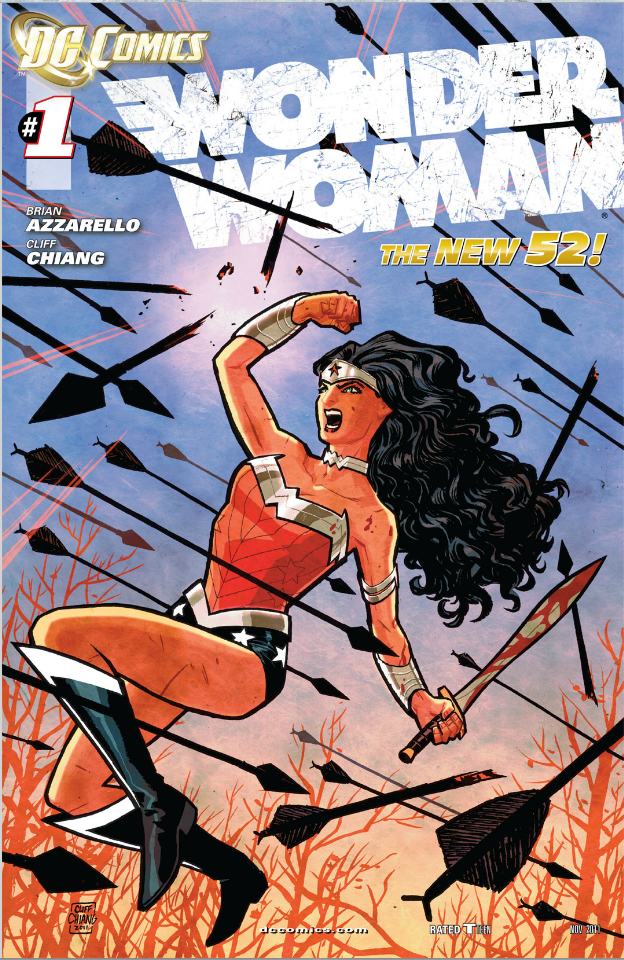
Cover A of Wonder Woman #1 from the New 52 (2011) featuring the art of Cliff Chiang
Cover A of Wonder Woman #1
from the New 52 (2011) featuring
the art of Cliff Chiang
The article is a good read and addresses a dramatic shift in Wonder Woman's origin story with DC's New 52 reboot of their story-lines in 2011. I am quite a fan of Cliff Chiang's art work for the series, but I have to agree with Doctor Bifrost's complaint that transforming Diana's back-story into the archetypal "paternal narrative" version of the hero journey has robbed the series of its vital spark. 

Ironically, in the second issue of the series, the comic itself presents the traditional story of Diana's birth: being shaped from the clay by her mother Hippolyta...
Images from Wonder Woman #2 (2011) by Brian Azzarello and Cliff Chiang depicting the traditional story of Diana's birth from clay with the textual narrative: "According to legend, Hippolyta -- the queen -- her womb was barren. Yet she desperately wanted a child... So, on a moonless night, she fashioned a child out of clay... and prayed to the gods for a miracle."

Images from Wonder Woman #2 (2011) by Brian Azzarello and Cliff Chiang depicting the traditional story of Diana's birth with a textual narrative: "When she was done, she fell exhausted...into deep slumber....And with the sun above, Hippolyta was awakened by her child. Wonder Woman is the perfect amazon -- no male seed created her."

...only to dismiss this original version of the story as legend used to cover up the nature of Diana's true birth. Hippolyta finally confesses: "There was a man. No, there was more than a man. There was a God. The God. There was Zeus."

Images from Wonder Woman #2 (2011) by Brian Azzarello and Cliff Chiang depicting Zeus and Hippolyta in combat with Hippolyta's textual dialogue: "There was a man. No, there was more than a man. There was a God. The God. There was Zeus."
Image from Wonder Woman #2 (2011) by Brian Azzarello and Cliff Chiang with textual dialogue between DIana and Hippolyta: D: "I wasn't made of Clay." H: "I had to protect you from Hera! She's--"
Brian Azzarello, the writer, utilizes the familiar trope of Hera's dangerous jealousy of Zeus' paramours and hatred of his bastard children from Greek myth as Hippolyta's rationale for lying to Diana about the true nature of Diana's birth. 

To add to the heartbreak Diana feels over her mother's lies, Azzarello depicts her as feeling ashamed of her "new" birth, so much so that she must exile herself from her sisters, her mother, and Paradise Island forever. 

Image from Wonder Woman #2 (2011) by Brian Azzarello and Cliff Chiang with text over image of Wonder Woman/Diana: "the Only Shame on this Island is MINE and I will Take it from you all...never to return."

Before this revelation, Diana's identity well into adulthood was of a woman born as a "perfect Amazon" -- someone so wanted that her mother's prayers created her, a miracle. Talk about taking the agency out of a female narrative. 

And by replacing it with the paternal narrative, Azzarello and the editors at DC have also replaced pride with shame as one of Wonder Woman's defining experiences.