Showing posts with label Bob Kane. Show all posts

Monday, May 30, 2016

Batman #3: Crushing on The Cat

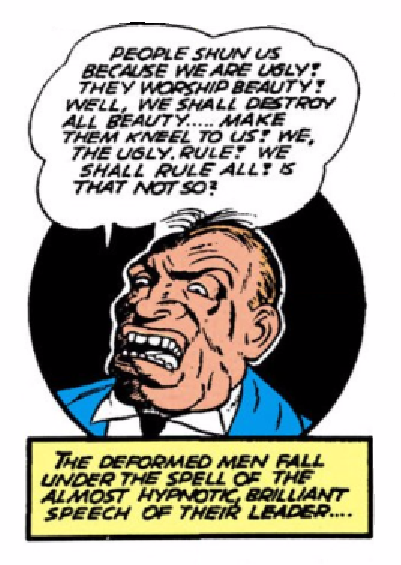
Batman (1940) #3 Page 19 Panel 7: The ugliest man on earth pledges to make war on beauty.
A "strange case," ugly = evil, and winning nascent criminal youth to the side of truth and justice with a boys' club: the three other stories in this issue that I will not be focusing upon.


Most Amusing Panel Prize (so many to choose from in this issue)

Batman (1940) #3 Page 24 Panel 5: Fraternity hazing goes very, very wrong or "how to make the world's ugliest man."An early sign that hazing at Fraternities has always been hazardous:

"What you got there, Tyler?"

Oh, it's a hypo "filled with a lot of drugs I mixed together haphazardly. I'll pretend to inject it into Carlson!"

Muwahahahaha... Surely nothing bad will come from that. Har, har, har.


Batman (1940) #3 Page 41 Panel 2: Cat-Woman makes her "debut" as a woman who has a head that looks like an actual cat's.I have chosen to focus on The Cat story from this issue because I cannot get over how the Cat-Woman's first appearance as the "Cat-Woman" (and not just "The Cat") includes having an actual Cat-head mask. (A cat-head with no neck, mind you.)

Surprising Details (there's nothing really surprising here):

As one might expect from a story written in the 1940's and featuring a female "villain," gratuitous evidence of male chauvinism abounds. (Heck, even Commissioner Gordon succumbs to a bout of male rage at the idea of a woman eluding the apparently all-male police force.)

Batman (1940) #3 Page 42 Panel 1: Sexism runs rampant when male egos everywhere are threatened by a woman getting away with her crimes.
Taking the stereotypical trope associating women with "cat-fighting," Cat-Woman threatens to "scratch out" the eyes of the duper who has double-crossed her in a diamond heist.

As Batman reluctantly (and apologetically) resigns himself to turning the Cat-Woman into the police for her part in the crime, she performs the perfect feminine escape technique of thanking Batman with a kiss (and a shove) as she makes a speedy exit.
Batman (1940) #3 Page 51 Panels 5-7: Catwoman segues a thank you kiss into an escape from Batman's clutches.


Batman (1940) #3 Page 52 Panel 2: Robin suggests it may have been okay that Catwoman got away because she is a "woman"??Batman is not too broken up over this slight to his own masculine crime-fighting capacities (I'm not sure if this makes him more sexist or less, but I'm going with less), much to Robin's dismay.

Batman doesn't seem to mind that a she has "beaten" a him, though Robin seems to think that there may be a double standard at play.

Batman's romantic ardor is reciprocated as Cat-Woman imagines Batman taking over the wheel (quite literally) and going "for a ride" with him "like any other boy and girl."

Batman (1940) #3 Page 52 Panel 8: Catwoman imagines how nice it may be to have Batman chauffeur her around in her car (like "just another boy and girl").(Granted, Batman has seen her out of her disguise three times now, but she still has no idea who he is under that cowl, but reciprocity nonetheless.)

Final Notions:

Despite the historical gender-baggage on Cat-Woman's shoulders, I still find her a strong female character even in these earliest issues. She works (she takes jobs as a criminal, yes, but it's still work); she is independent (and relies on no man for her subsistence), and she is tough and scary to those who have crossed her (righteous, even, in her threats to scratch them).

There is good reason why Catwoman and Lois Lane have been enduring icons of comic book women. They are complete women on their own heroic adventures. Their stories intersect with those of their male counterparts, but there is a very real sense that their stories continue on even outside the presence of Bruce Wayne/Batman and Clark Kent/Superman.


Batman (1940) #3 Cover
Series: Batman (1940)

Issue #: 003

Copyright: DC Comics

Cover Date: Fall 1940

Cover Price: 10¢

Page Count:  54 pages

Print Release: 24-July-1940

Digital Release: 25-May-2011


Writer:
DC Comics Logo
Penciler:
Inkers:
Colorist:
None Listed
Cover Art:
Source Links:
Story Titles:
“The Strange Case of the Diabolical Puppet Master”; “The Ugliest Man in the World”; The Crime School for Boys”; “The Batman vs the Cat-Woman”


Friday, May 27, 2016

Batman #2: The Cat Saves the Bird & PC Policing

In the second issue of Batman, there are again four stories all starring Batman & Robin in some 53 pages (I think comiXology counts the cover as a page in its page totals. However, there are no ads in these electronic issues, so that's cool).

Most Amusing Panel Prize:

"He's very cute! Cute is just the word for him!"
Batman (1940) #2 Page 44 Panel 7: Batman gets up close and personal with Goliath, the friendly "missing link."

Surprising Details: 

In "The Joker Meets the Catwoman," Batman has an incredibly disturbing plan to prevent The Joker from resuming his nefarious criminal activities after he recovers from his injuries (sustained in the last issue).

Batman (1940) #2 Page 2 Panel 2: Batman's plan for The Joker involves a little brain surgery to "heal him."Batman explains to Robin that he wants to "abduct the Joker....then we'll take him to a famous brain specialists for an operation, so that he can be cured [emphasis added]."

He wants to have brain surgery performed on someone without their permission!?

Jolly.

In a perplexing misdirection, the Weasel (who also wants to abduct The Joker so that The Joker (whose chances at recovery are reportedly "very slim") can become the brains of Weasel's criminal organization?) -- Weasel has one of his men pretend to be Batman to distract the police.
Batman (1940) #2 Page 11 Panel 7: The Cat offers the jewels to save the Robin from the Joker.
Before this deception is revealed, however, everyone (including me) wonders when the Batman became willing to kill policemen.

(Given that I knew so little about Batman's history of killing the "bad guys," for a moment I feared that Batman was perhaps even more criminal than I had begun to believe...)

In this story, The Joker and Catwoman meet for the first time when both attempt to burgle the Pharaoh's Gems. They fight to see who will take home the gems, but when Robin's life is put in jeopardy by The Joker, it is the Catwoman who is willing to sacrifice the loot in order to save the Boy Wonder.

The Other Stories (in this issue):

One struggle I have with these early issues is that my personal frame of reference is loaded with modern politics that intersect poorly with the conscious (and unconscious) politics of the writers and artists from the time period in which these comics were created.

Batman (1940) #2 Page 43 Panel 3: Batman recognizes something queer is going on when he sees it.I am old enough to have been raised on classic Black & White movies and early television programs on endless repeat on Sunday mornings. There is an uncomfortable familiarity in these tales of the Bat in which simplistic (and therefor often stereotypical) portrayals of people who are "different" are common practice.

My awareness that these pieces are products of their time period does nothing to silence my inner literary critic who wants to tear apart the sexism and able-ism and racism presented in these stories.

But, when the depictions are so overt and noxious, do they really require explicit analysis to identify them for what they are?

So, to comment or not to comment? Align myself with the SJWs (Social Justice Warriors) or skip over such commentary to avoid the risk of becoming oversimplified and stereotyped myself under the latest label the right uses to demonize/dis-empower the political left?

"The Case of the Missing Link," the last of the four tales in this issue, bears the weight of both white colonialism and a limited understanding of scientific evolutionary theory.

Batman (1940) #2 Page 44 Panels 2 & 3: The Doctor explains how he acquired the gigantic "missing link."

In this story, a pituitary gland deformation turns the "missing link" into a giant whom the pygmies of Africa worship as a "god" and whom the Western white scientist has kidnapped in order to "civilize" him.

Luckily, Batman is there to save the day (...or not, as every major player who is not Batman or Robin is dead by the end of the story).

Batman (1940) #2 Page 45 Panel 5: The Doctor refuses to "put Goliath on display" to make a profit.And yet, there is criticism within this story over the exploitation of others expressed by the white scientist who recognizes that the intentions of the two "bad guys" to display Goliath (the missing link) for profit is wrong (even though he remains uncritical of his own desire to "civilize" Goliath).

And Batman expresses sympathy for the "monster," Goliath, when -- in a berserker rage of grief after his "master" (the white scientist) has been killed -- he attacks Batman and dies as Batman defends himself.

Batman directs Robin (and the reader) to recognize that the two men (now dead) who meant to exploit Goliath for profit were the "real monsters."

Last Notions:

I look forward to getting to some contemporary tales with characters who share a greater resemblance to me. Not because I am inherently narcissistic (though I often fear I am), but because variety enriches my understanding of the universe (and so far I have encountered no butch nerd feminists whatsoever in these pages).


Batman (1940) #2 Cover
Series: Batman (1940)

Issue #: 002

Copyright: DC Comics

Cover Date: Summer 1940

Cover Price: 10¢

Page Count:  53 pages

Print Release: 22-May-1940

Digital Release: 25-May-2011


Writer:
DC Comics Logo
Penciler:
Inkers:
Colorist:
None Listed
Cover Art:
Source Links:
Story Titles:
“The Joker Meets the Catwoman”; Wolf, the Crime Master”; “The Case of the Clubfoot Murders”; “The Case of the Missing Link”


Monday, May 23, 2016

A Bird, a Card, and a Cat (Detective #38 & Batman #1)

Detective Comics (1937) #38 Page 3 Panel 9: The announcement of Dick Grayson's new identity as Robin.
Detective Comics #38 and Batman #1 appear to have been released in the same month in 1940, and they introduce three major players to the Batman Universe: Robin (Dick Grayson), The Joker, and Catwoman.

The story introducing Robin in Detective Comics is but 12 pages of the mag (which has several other noirish stories in it). Issue #1 of Batman, on the other hand, has four complete Batman stories, two starring The Joker, one with Hugo Strange (a villain who has appeared in Detective Comics in an issue I don't own), and one with The Cat (Catwoman).

Most Amusing Panel Prize:
Somehow, the Batman gets The Joker to stab himself?
Batman (1940) #1 Page 52 Panel 5: Batman manages to make The Joker stab himself somehow.

Detective Comics (1937) #38 Page 3 Panel 3: Batman invites Dick Grayson to fight crime with him as they have both lost parents to criminals.Constructing a parallel origin story for Batman's first sidekick, Dick Grayson, was a masterful choice. Many excellent questions about the nature of grief and vengeance and heroism have come from young Robin joining Batman on his mission to fight criminals like those responsible for the deaths of both sets of their parents.

(However, "exterminating them" may be a bit heavy-handed in its approach.) (Also, the English teacher in me is dismayed that Batman uses the exact same language as the narrator in this panel.)

Batman (1940) #1 Page 12 Panel 3: Batman puns as he strikes The Joker.
Surprising Details:

What surprised me most about the introduction of the Joker is how punny Batman is in these early issues. I thought bad puns were a vestige of the 1960's TV show, but apparently they make their appearance way earlier in the history of Batman.

In this issue, both Batman and The Joker deal pun after pun related to a deck of cards (the signature of The Joker's imagery).

Batman (1940) #1 Page 20 Panel 5: Batman gets Hugo to monologue about his nefarious plans.
Criminal monologue-ing has also had a lengthy history in comics, it seems, as Batman invites his first recurring villain, Dr. Hugo Strange, to explain his crazy plan (which Hugo is more than happy to do).

(His crazy plan involves turning escaped lunatics into giant monsters whom he intends to let loose on the public as a distraction so his men can "loot the banks.")

Batman (1940) #1 Page 39 Panel 1: Batman is a creepy sexist when he reveals The Cat by wiping off her disguise.
Horribly sexist and tacky, Batman's first encounter with Catwoman (in which he wipes off her disguise as an old woman) simply creeps me out: "Quiet or Papa Spank!" UGH.

Plus, she employs her notoriously stereotypical "feminine wiles" to try to enlist Batman into becoming her partner. Who's surprised?

In fact, the only redeeming quality in the pair of panels below is the humor created by the juxtaposition of Robin's dialogue with his obliviousness to the interchange between Batman and "The Cat."

Batman (1940) #1 Page 40 Panels 1 & 2: The Cat tries to persuade Batman to switch sides. He refuses.


Batman (1940) #1 Page 24 Panel 8: Batman "hate[s] to take human life" unless it is necessary.In the first issue of his self-titled mag, Batman also expresses (for the first time in my comic collection) a reluctance to kill, even though he asserts he will kill if "necessary."

I find the concept of the sacredness of life (typically phrased as "human life," but all life fits, too) to be central to my understanding of superhero-ing.

What typically separates the "good guys" from the "bad guys" is the moral culpability they feel at the loss of life caused by their efforts to attain their goals.

Final Notions:

It is cool to know that the fundamentals I have picked up about these characters in the Batman Universe (from modern renditions and pop culture) can actually be found in the source texts themselves.

Regardless, these early issues are a bit of a chore to slough through. I may have to hit warp speed so I can get to some material that will make for better reading (especially for those earnest enough to read my blog).


Detective Comics (1937) #38 CoverSeries: Detective Comics (1937)

Issue #: 038

Copyright: DC Comics

Cover Date: April 1940

Cover Price: 10¢

Page Count: 59 pages

Print Release: 21-February-1940

Digital Release: 17-August-2012


Writer:
DC Comics Logo
Penciler:
Inker:
Colorist:
None Listed
Cover Art:
Source Links:
Story Title:
“Robin the Boy Wonder”


Batman (1940) #1 Cover
Series: Batman (1940)

Issue #: 001

Copyright: DC Comics

Cover Date: Spring 1940

Cover Price: 10¢

Page Count: 54 pages

Print Release: 28-February-1940

Digital Release: 25-May-2011


Writer:
DC Comics Logo
Penciler:
Inker:
Colorist:
None Listed
Cover Art:
Source Links:
Story Titles:
“The Joker”; “The Giants of Hugo Strange”; “The Cat”; “The Joker Returns”


Friday, May 13, 2016

Detective Comics #27 (and #28)

Since my electronic copy of the next oldest comic in my collection contains only the 7 pages from Detective Comics #27 in which Bat-Man first appears (available for free on comiXology), I'll also tackle the 7-page Bat-Man story from issue #28 (which comiXology so thoughtfully combined with issue #29 into one 99¢ "issue").

Most Amusing Panel Prize (Detective #27):
Bruce Wayne's blase reply to his friend, Commissioner Gordon's, 
invite to visit a murder scene with him: "Oh Well. Nothing else to do."
Detective Comics (1937) #27 Page 1 Panel 4: Blase Bruce Wayne, socialite, invited to a murder scene by Commissioner Gordon.

Surprising Details: 

Detective Comics (1937) #27 Page 3 Panels 9 & 10: Batman speeds off in his red sedan.I was a tad disappointed to discover that the Bat-Mobile is in fact but a red sedan in the early issues of Detective Comics; however, Bat's utility belt does make an appearance in issues 28 as the source of his "silk rope" that helps him make his escape.


Detective Comics (1937) #28 Page 2 Panel 8: Batman's utility belt saves the day.

Dual Identities: 

The motif of dual identities, oft commented upon and requiring no addition from me, will nevertheless be touched upon here because how could I not? This motif is introduced with the first appearances of both Superman and Batman.

What I find difficult to determine is which alter ego I find the most dismaying.

Action Comics (1938) #1 Page 7 Panel 2: Lois stands up for herself while Clark acts the wimp.
Clark Kent, Superman's guise, is willing to sacrifice Lois' safety and comfort in order to maintain his rouse of being a "weakling" while on their first date. However, Clark's refusal to "defend" Lois from the sexist advances of Pushy Guy does, in fact, undermine the notion that a woman needs a man to defend her, which is cool.

Detective Comics (1937) #27 Page 6 Panel 8: Commissioner Gordon muses about Bruce Wayne's apparent apathy despite his being a "nice guy."His pretense also sets up Lois' brilliant retort when Clark suggests she dance with Pushy Guy to appease him. Lois: "You can stay and dance with him if you wish but I'm leaving NOW."

Bruce Wayne plays the bored socialite, but as a 1%-er, his feigned lack of "interest" in the murder of a fellow 1%-er makes him appear truly callow, especially since Bruce's motivation for his crime fighting (the death of his parents at the hands of an armed criminal) has not yet been established.

The intention seems to be to create a humorous contrast between Bruce Wayne's "boring" life and Batman's exciting one, but Batman's use of violence in this issue (and those that follow) dampens that levity.


Detective Comics (1937) #27 Cover
Series: Detective Comics (1937)

Issue #: 027

Copyright: DC Comics

Cover Date: May 1939

Cover Price: 10¢

Page Count: 7 pages

Print Release: 15-March-1939

Digital Release: 10-September-2011


Writer:
DC Comics Logo
Penciler:
Inker:
Colorist:
None Listed
Cover Art:
Source Links:
Story Title:
The Batman: “The Case of the Chemical Syndicate”

Most Amusing Panel Prize (Detective #28):
Bat-Man's secret ID is not so secret (in case you have forgotten what is revealed at the end of the last issue. (Hint: He's Bruce Wayne.)
Detective Comics (1937) #28 Page 1 Panel 1: Brief Summary of Batman (for first-timers who missed out on last issue)

Heroes or Hooligans?:

What I find most interesting is how much these early incarnations of Batman and Superman resort to the very violence they would stop in others

Both Batman and Superman use their skills/strength to intimidate and menace the "bad guys."

Action Comics (1938) #1 Page 13 Panel 3: Superman "flies" the corrupt Washington lobbyist around the capitol.
In Action Comics #1, in order to get information out of a corrupt Washington lobbyist, Superman abducts him and dangles him from various heights throughout the capitol. 

The fact that Superman seems to enjoy his terrorizing of another person does not help.

Batman's record over two issues is even more distressing. In Detective Comics #27, Alfred Stryker is responsible for two murders and the attempted murder of a third business partner, all because of his greed.

Clearly the man deserves incarceration and punishment; however, in Batman's effort to stop Stryker, he strikes him and Stryker falls into his own "tank of acid."

Detective Comics (1937) #27 Page 6 Panels 3 & 4: Murderous businessman Alfred Stryker plummets to his death in an acid pit for which Batman feels no compunction.
For this death, Batman feels no remorse declaring it a "fitting death for his kind" (his kind presumably being the criminal one).

Batman again grapples with a "bad guy" in issue #28 who also plummets to his death, this time off the roof of a high rise.

Detective Comics (1937) #28 Page 1 Panels 7 & 8:: Oops! There goes one of the bad guys off the roof.


Batman later dangles the leader of this band of thieves out a window, threatening to drop him if he does not confess to his crimes.

Detective Comics (1937) #28 Page 5 Panel 6 & Page 6 Panel 2: Batman terrorizes and beats the "bad guy" into submission.


After he consents and Batman brings him up to safety, the thief tries to escape, and Batman beats him so thoroughly, the man begs for Batman to stop: "Don't hit me like that again. Please don't hit me. Don't...."

Last Notions:

Do these heroes need dual identities because seeking justice against criminals requires criminal behavior in the corrupted currents of this world and they need a place to hide from the consequences of their "crimes"?

Or does the capacity for menace that both Superman and Batman possess require weak/disinterested guises to hide the depth of the violence of their antisocial tendencies.

And was the violence that Batman and Superman use in these early episodes acceptable to its contemporary audience in part because it is only inflicted upon criminals?


Detective Comics (1937) #28 CoverSeries: Detective Comics (1937)

Issue #: 028

Copyright: DC Comics

Cover Date: June 1939

Cover Price: 10¢

Page Count: 7 pages

Print Release: 19-April-1939

Digital Release: 10-September-2011


Writer:
DC Comics Logo
Penciler:
Inker:
Colorist:
None Listed
Cover Art:
Source Links:
Story Title:
The Batman: “Frenchy Blake’s Jewel Gang”